
Metal finishes
Stainless steel, restored on site — not replaced
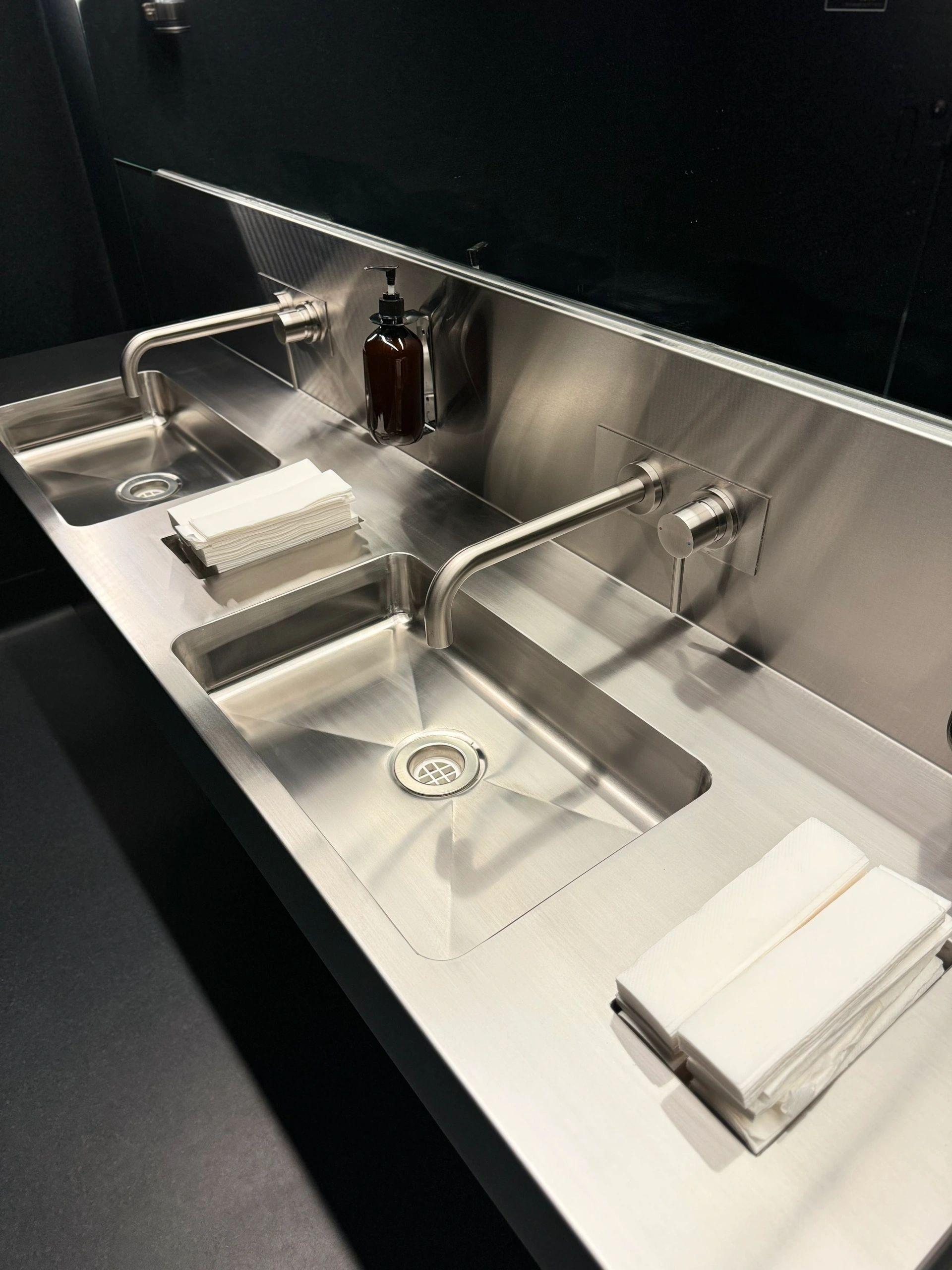
A scratched lift door or handrail shouldn't cost you a lead-time. We polish and restore stainless steel in situ — handrails, handles, sinks and lift doors — so a replacement never lands on the critical path.
What it is
The scope, done right
Architectural stainless steel that gets scratched, scuffed or marked during the build is a handover problem, not a manufacturing one — and replacing a handrail or lift door means lead-time the programme rarely has. M&M restores stainless in place: handrails, handles, sinks, lift doors and cladding, matched back to the surrounding finish. The item stays put and the defect closes without touching the critical path.
M&M carries out stainless-steel restoration on site, across the full range of architectural stainless a builder hands over — handrails and balustrades, door hardware and handles, stainless sinks and benches, splashbacks and cladding, and lift-car doors and linings. Where a panel or rail has been scratched, scuffed or marked by following trades, we restore it in situ rather than send it back for re-order.
Stainless is one of the last finishes to be protected and one of the first to be marked — by trolleys against a lift architrave, tools against a handrail, adhesive and silicone smears, or scaffold and access damage. Each mark becomes a line on the defect register, and the default remedy is replacement: a new item ordered against a manufacturing lead-time, re-installed by disturbing adjacent trades, with retention held and sign-off stalled until it lands. In-situ restoration takes that item off the critical path entirely.
The substrates and conditions matter, because stainless is not one finish. Most architectural work is grade 304, with grade 316 specified where corrosion resistance is needed — external, wet or coastal locations around Sydney and Melbourne. Surface finishes range from the brushed, directional No.4 satin most handrails carry, to fine hairline and linished grains, to mirror polish and bead-blast. Damage arrives as directional scratches and scuffs, weld heat-tint, adhesive residue, and — on 316 in marine air — tea-staining and light surface corrosion. A common and often invisible cause of rust on new stainless is cross-contamination: carbon-steel grinding dust or tooling embedding iron particles in the surface, which then flash-rust. Reading which of these is present is what decides the method.
The craft is in matching the existing finish, not simply removing the mark. Stainless has a grain, and a repair that ignores grain direction reads as a patch under raking light. Our tradespeople work the affected plane through a progression of abrasive grits, following the original grain and carrying the blend out to a natural break line — an edge, a joint, a change of plane — so there is no visible boundary between repaired and original. Where iron contamination or tea-staining is the issue, the surface is cleaned and passivated to restore its corrosion resistance rather than just its appearance. Before mass work begins, a sample area is prepared and the finish agreed, so what gets signed off is what was specified.
Because the work sits inside a single subcontract, a run of metal defects across a lobby, lift core or amenities fit-out is one visit and one closed section of the register — and the same crew handles scratched chrome and adjacent surface defects rather than leaving you to coordinate three trades. M&M brings project-specific trained tradespeople working under quality-control managers, with day and night shifts and surge labour to hold a handover date. Every item is captured in ITP documentation and time-stamped images made available to you on OneDrive, so each rectification is fully recorded — a clear trail for the register and the defects liability period.
The result is a finish you keep rather than an item you re-order, restored to the specified appearance and corrosion resistance. Twenty-five years in the finishing trade, a 90-plus-strong team of skilled staff across Australia, and workshop and on-site capability sit behind it.
Where this scope earns its keep: lift cores and lobbies at settlement.
What's included
Everything this scope covers
- On-site restoration of stainless handrails and balustrades
- Stainless door hardware and handles
- Stainless sinks, benches and splashbacks
- Lift-car doors and lift-lobby architraves and linings
- Stainless cladding and feature panels
- Directional-grain (No.4 / satin / hairline) finish matching
- Mirror and bead-blast finish restoration
- Scratch, scuff and weld heat-tint removal
- Adhesive, silicone and site-residue removal
- Tea-staining and light surface-corrosion treatment with passivation
- Scratched chrome rectification (same crew)
- Sample preparation and finish sign-off before mass work
- ITP documentation and time-stamped progress images via OneDrive
What this fixes
The handover risks this scope removes
Replacement lead-time off the critical path
A scratched lift door or handrail no longer means re-ordering an item against a manufacturing lead-time and re-installing it. Restoring in situ closes the defect in place, so a metal mark stops holding up sign-off.
A clear record of the damage and the repair
Time-stamped images and ITP records document the damage and the rectification, giving you a complete, traceable record of each item for the register and handover.
Multi-trade coordination collapsed into one
Stainless, chrome and adjacent surface defects across a lobby or lift core are handled by one crew under a single subcontract — one visit and one closed section of the register instead of three separate trades to chase.
Retention and replacement cost protected
Restoring the existing item avoids the replacement bill and the re-installation disruption, and shortens the defect list that is holding your retention.
How we do it
A documented method, every time
Survey and register reconciliation
We walk the affected areas with your defect register, identify each stainless item, its grade and finish, and the cause and depth of damage — separating surface scratching from heat-tint, contamination and corrosion, because each takes a different method.
Sample and finish sign-off
On a representative item we prepare a sample area and agree the target finish and grain direction with you before any mass work. This fixes the standard so the signed-off result matches the surrounding specified finish rather than a guess.
Method statement, ITP and protection
We set the method against an inspection and test plan, arrange access and protection of adjacent glass, stone and joinery, and sequence around other trades so restored surfaces are not re-damaged behind us.
In-situ restoration, day or night
Tradespeople work the surface through a controlled abrasive progression following the original grain, blending to a natural break line so there is no visible patch. Night and surge shifts are used where the area must stay operational or the handover date is tight.
Clean, passivate and QA
Where iron contamination or tea-staining is present the surface is cleaned and passivated to restore corrosion resistance, then each item is inspected against the agreed sample under raking light before it is called complete.
Documentation and sign-off
Completed items are captured in ITP records and time-stamped images on OneDrive and walked back against the register with you, so each defect is evidenced closed and the paperwork stands up.
Why it holds up
Evidence, not assurances
Restored in place, not re-ordered
On-site restoration is the specialty — no removal, no manufacturing lead-time, no re-installation disturbing finished areas around it.
Grain and finish matched to a signed-off sample
We assess the existing grade and finish, prepare a sample and agree it with you before mass work, then blend to a natural break line so the repair reads as original under raking light — not as a patch.
Corrosion resistance restored, not just appearance
Where iron contamination or tea-staining has taken hold, the surface is cleaned back and restored, rather than left to look clean while it continues to rust.
One subcontract across the metal defects
The same crew handles scratched chrome and adjacent surface defects alongside the stainless, so a run of finishing defects is one team and one closed item on the register.
Documented for the register and handover
ITP documentation and time-stamped images on OneDrive record each rectification — a complete trail to close the defect and support the defects liability period.
Labour that surges to your date
Project-specific trained tradespeople under quality-control managers, with day and night shifts and surge labour, backed by 90-plus staff across Australia.
Proof
Case studies featuring this service
Service areas
Popular areas for stainless steel polishing
Start with a local scope page, or send us the site address and we will confirm coverage.
Questions
What builders ask us
Projects in safe hands